Don't miss our holiday offer - up to 50% OFF!

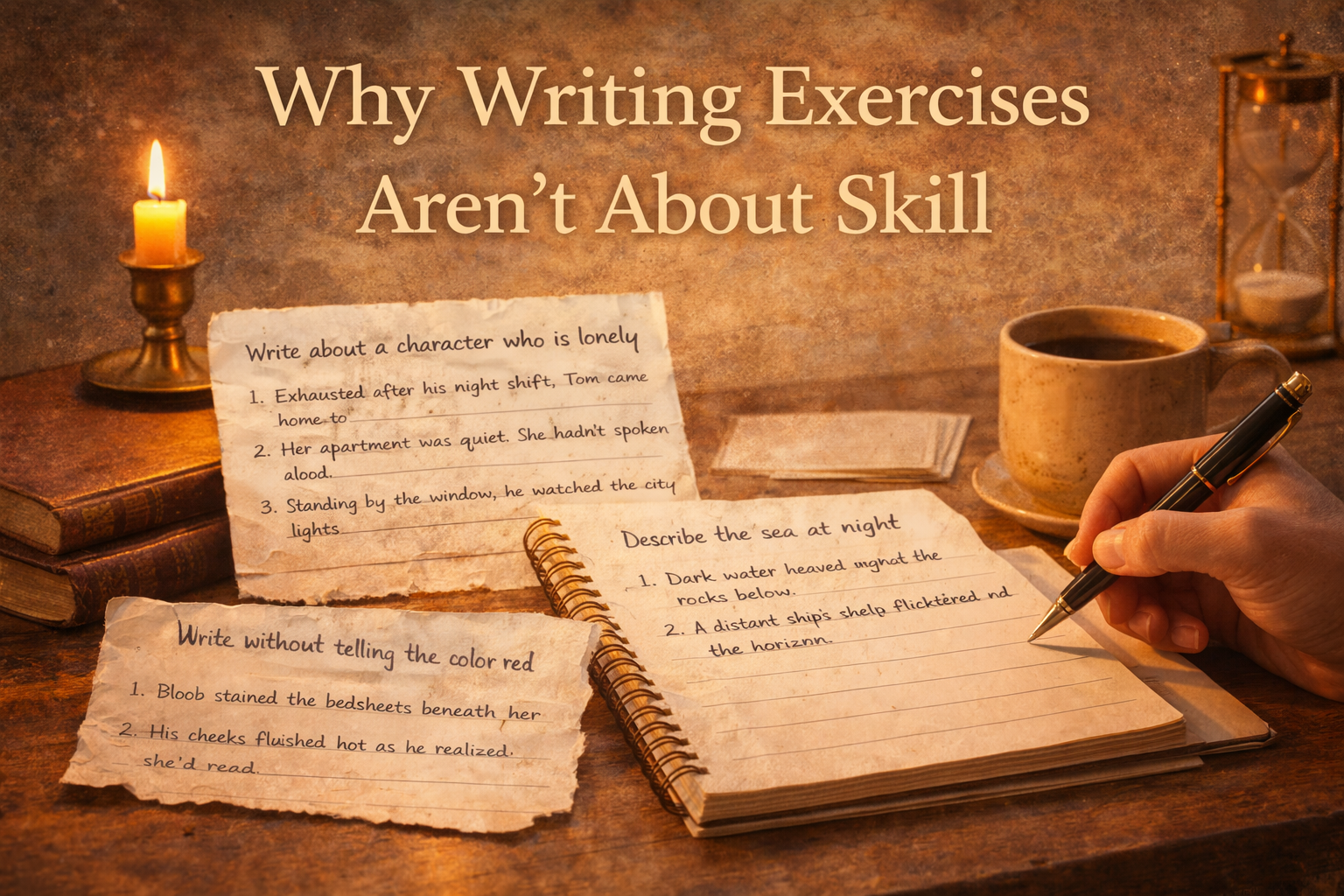

But About Access
For a long time, I misunderstood writing exercises.
I thought they were drills — ways to improve technique, sharpen craft, or fix what wasn’t working. Something you did before the real writing began, or when you weren’t yet good enough to trust yourself.
I no longer see them that way.
For me, writing exercises aren’t about becoming more skilled. They’re about gaining access.
Skill Is Visible. Access Is Quieter.
Skill shows up on the page.
It can be assessed, compared, refined.
Access is something else entirely.
Access is the moment when the writing starts to move through you rather than being pushed out by effort. When the sentences arrive before you know where they’re going. When you surprise yourself — not with cleverness, but with honesty.
No amount of technical competence can guarantee that moment.
But the right invitation can.
Exercises Lower the Stakes
Most of us don’t struggle because we lack skill. We struggle because the stakes feel too high.
We sit down to write and immediately feel watched — by imagined readers, future editors, our own inner critic. The page becomes a place of judgment rather than exploration.
A writing exercise gently lowers the stakes.
It says: You’re not writing a piece. You’re responding to an invitation.
There’s no outcome to protect. No standard to meet. Just a doorway to step through.
Access to What We Don’t Yet Know
When I use writing exercises, I’m not trying to produce something good.
I’m trying to hear something I don’t yet have language for.
Exercises create a small container — a sentence starter, a time limit, a sensory focus — that keeps the mind occupied just enough for something deeper to speak.
They help me bypass the part of myself that wants to control the writing, and make room for the part that wants to reveal.
Why This Matters for Reflective Writing
This is especially true when writing about the inner life — journalling, reflection, year-in-review work.
There are things we can’t think our way into understanding. They have to be approached sideways.
An exercise like “Begin with ‘What I haven’t admitted yet is…’” doesn’t demand insight. It creates access to it.
The page becomes a listening space, not a proving ground.
Exercises as Permission, Not Prescription
The most helpful writing exercises don’t tell us what to say.
They tell us where to begin.
They offer permission:
- To be unfinished
- To contradict ourselves
- To stop early
- To write something we’ll never share
In this way, exercises are less like instructions and more like thresholds.
You don’t cross them to show what you know.
You cross them to discover what’s waiting.
Returning to the Page
When writers say they’re stuck, I rarely hear a lack of ability.
I hear a lack of access.
Writing exercises don’t solve that by teaching us more. They solve it by asking less.
Less polish. Less certainty. Less self-surveillance.
And often, in that gentler space, the writing returns — not because we forced it, but because we finally made room.
A Small Invitation
If you’d like to experience this for yourself, try this:
Set a timer for five minutes and begin with:
“What’s trying to come through right now is…”
Don’t finish the thought. Let the sentence open instead of close.
Stop when the timer ends.
Writing doesn’t always need to be better.
Sometimes it just needs to be allowed.