Don't miss our holiday offer - up to 50% OFF!

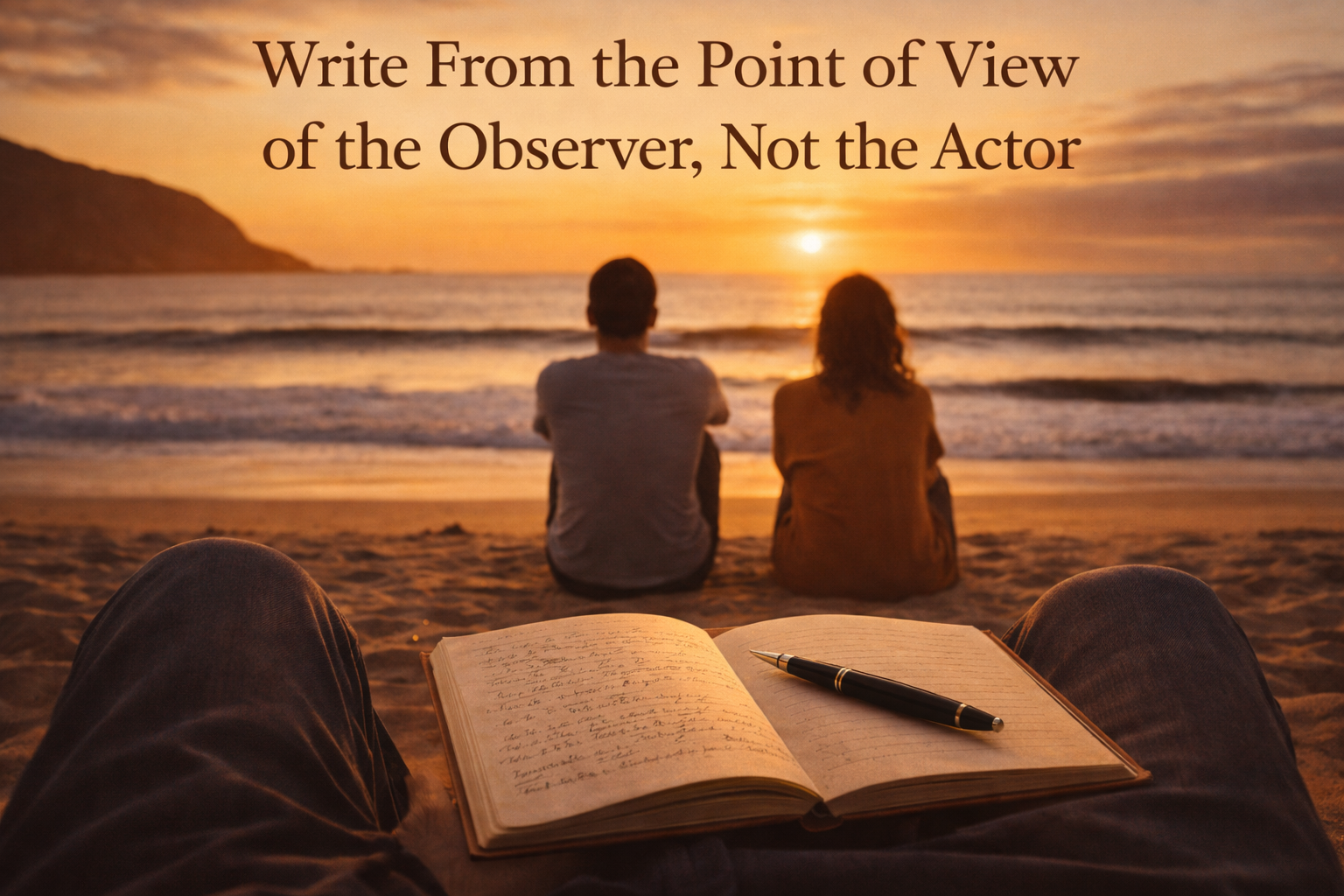

Someone watching the moment, not living it
When we write a scene, we instinctively place ourselves inside it.
We become the protagonist.
We feel what they feel.
We move as they move.
But there’s another way into a moment — and it can quietly transform the writing.
Instead of writing as the actor, write as the observer.
Someone in the room.
Someone at the edge of the frame.
Someone who sees what the main character cannot see about themselves.
This shift in perspective can open surprising depth.
Why This Works
The actor is immersed in emotion. The observer has distance.
Distance brings different kinds of truth.
An observer notices:
- The hesitation before someone speaks
- The way a hand tightens around a glass
- The silence that follows a sentence
- The energy in the room that no one names
Observers see patterns. They see contrast. They often see irony.
And because they are not the centre of the action, they are free from the need to justify it.
Choosing Your Scene
For this exercise, choose a favourite scene from:
- A novel you love
- A film that stays with you
- Or the book you’re currently reading
Don’t choose something abstract or epic. Choose a contained moment — a conversation, a decision, a departure, a reveal.
Then imagine someone else was there.
Not a main character.
Not a narrator.
Just someone present.
It could be:
- A stranger at the next table
- A neighbour watching through a window
- A minor character barely mentioned
- A passer-by who pauses just long enough to notice
You’re not rewriting the plot.
You’re changing the angle.
What Changes When You Step Back
When you write from the observer’s perspective, the emotional tone often softens and sharpens at the same time.
Softens — because you’re no longer inside the intensity.
Sharpens — because you can see it clearly.
The observer might misinterpret what’s happening.
They might sense tension without knowing why.
They might recognise something the main character is blind to.
In doing so, they reveal layers the original scene only hinted at.
What This Teaches You as a Writer
This exercise strengthens more than technique.
It strengthens perception.
It trains you to look at moments from multiple angles. It develops your ability to see behaviour rather than just emotion. It reminds you that every scene contains more than one truth.
It also gently separates you from your own work.
If you’re drafting something personal or emotionally charged, writing from the observer’s position can give you enough distance to approach the scene without overwhelm.
Sometimes stepping outside the moment allows you to see it more honestly.
The Invitation
Choose a scene.
Set a timer for 10 minutes.
Begin with something simple:
“From where I was standing, it looked like…”
Let the observer describe only what they can see, hear, and sense.
No need to resolve the scene.
No need to conclude it.
When the timer ends, stop.
You may find that the scene feels different now — not because it changed, but because you did.